What is a hotel PMS?

If you run a small hotel, guesthouse or B&B, you have probably been told you need a PMS. The acronym gets used as though everyone already knows what it covers, and the definitions online tend to be written by software companies describing their own product. Here is a plain account of what a property management system actually is, what it does, and how to tell whether yours is doing its job.
The short definition
A hotel PMS — property management system — is the system of record for your rooms and your guests. It knows which room every guest is in, on every night, what they owe, and what has been paid. Everything else a hotel system does is built on top of that.
That sounds modest. In practice it is the difference between a hotel that can answer "is room 12 free next Tuesday?" in two seconds and one that has to go and look.
What a PMS actually does
Holds the calendar
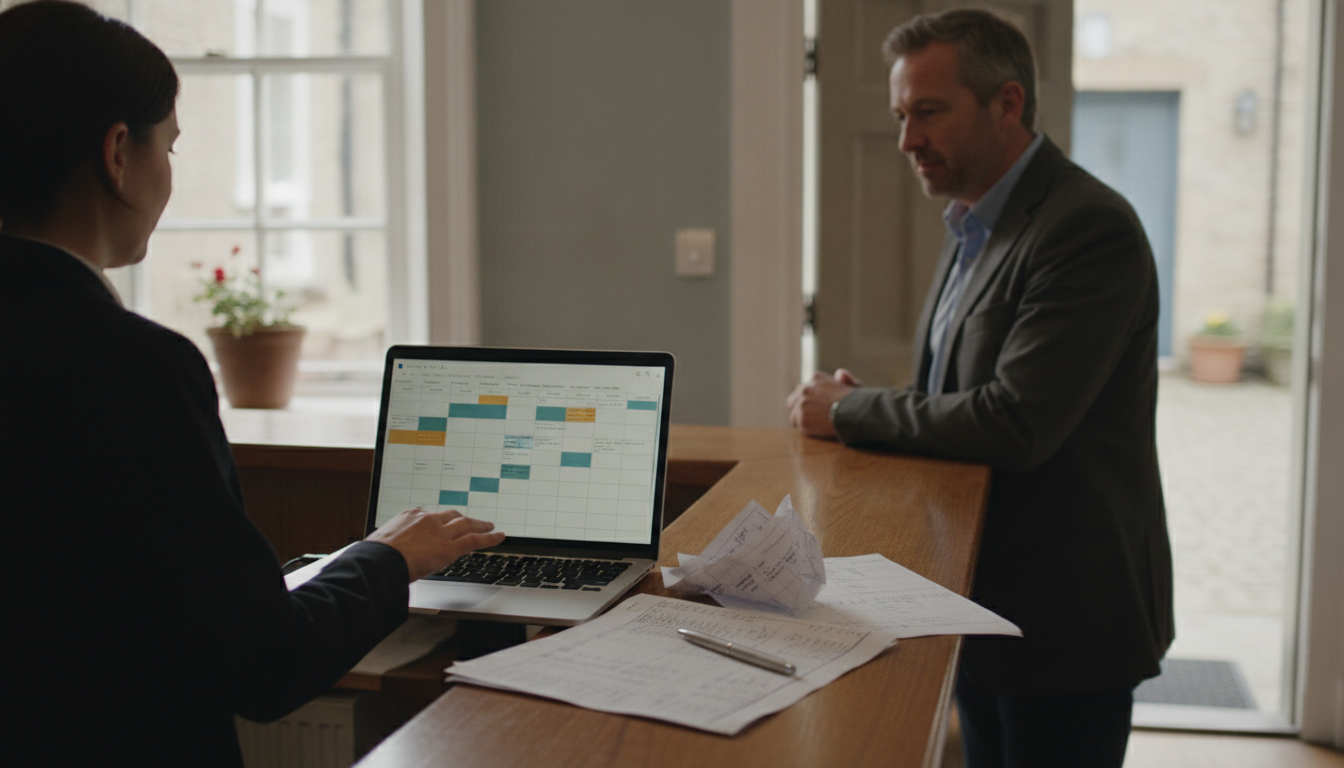
The central screen of any PMS is a grid: rooms down one side, dates across the top, bookings as blocks. This is where a booking is created, moved, extended or shortened. A good calendar lets you drag a booking from one room to another and updates everything downstream without being asked.
Assigns a real room to every stay
This is the part people underestimate. An online travel agent sells a room type — "one Standard Double". Your PMS has to turn that into a specific physical room that is free for every night of that stay. Those are different problems, and the gap between them is where overbookings come from. We wrote about that in detail in why your channel manager still oversells you.
Keeps the money straight
Every stay has a folio: the running account of room charges, extras, deposits and payments. The PMS builds it, applies the right rate for each night, handles VAT, and produces the invoice. If your folios and your card takings disagree at the end of the week, that reconciliation work is the PMS failing at its job.
Tells you what happened
Occupancy, average daily rate, RevPAR, revenue by source, arrivals and departures for tomorrow. A PMS holds the only complete record of your trading, so it should be able to answer these without anybody opening a spreadsheet.
What a PMS is not
Three systems get confused with the PMS constantly, and knowing the boundaries makes buying decisions much easier:
- A channel manager pushes your rates and availability out to Booking.com, Expedia and the rest, and pulls their bookings back in. It distributes; it does not run your hotel.
- A booking engine is the checkout on your own website. It takes a direct booking and hands it to the PMS.
- A website builder makes the site the booking engine sits inside.
Some vendors sell all four as one platform; others sell one and integrate with the rest. Neither approach is automatically better, but every join between two systems is somewhere data can drift. We set out the differences properly in PMS, booking engine and channel manager: what's the difference.
Do you need one at 8 rooms?
Plenty of small properties run on a paper diary or a spreadsheet, and for a while that works. The point at which it stops working is usually not size — it is channels. One booking source is manageable by hand. Three or four, each with its own calendar, is not: the moment two of them can sell the same night, you are relying on somebody noticing quickly.
A reasonable test: if you would be uncomfortable taking a week off because nobody else could work out the bookings, the system is in your head rather than in a system.
Signs your current PMS is holding you back
- You log into an OTA extranet to change a rate. Rates should be set once and pushed everywhere.
- You cannot see last month's RevPAR without building it yourself.
- Overbookings happen and nobody can explain why afterwards.
- Your website bookings arrive by email and are typed in by hand.
- The system is installed on one computer at reception, and only that computer.
- Support means a ticket queue and a three-day wait.
None of these are unusual. Most independent hotels are running something that was chosen years ago for reasons nobody present can remember.
Cloud or installed?
An older PMS runs on a machine in the back office; a modern one runs in a browser. The practical differences are access from anywhere, no server to maintain, updates that happen without you, and — usually — a monthly subscription instead of a large licence fee. There are legitimate reasons to prefer on-premise, mostly around connectivity. We weigh them up in cloud vs on-premise hotel PMS.
What it should cost
For an independent property, expect a flat monthly subscription scaled to room count rather than a percentage of your revenue. Be careful with anything priced per booking: it grows exactly when business is good. Hotel PMS pricing in the UK goes through the real numbers.
Where to start
Before you look at any software, write down the five things that take you longest each week. Then make every vendor show you those five things in a demo, with your data if they will allow it. A PMS that handles your actual work badly is worse than the spreadsheet you understand.
InnCloud is a cloud PMS for independent UK hotels, with the channel manager, booking engine and website included. Start a 7-day free trial or see pricing.
One platform for your whole hotel
PMS, channel manager, booking engine and website — flat monthly price, no commission on your bookings.
Start your 7-day free trial