Where ten hours a week goes in an independent hotel
Ask an independent hotelier where their week goes and you will hear "everywhere". Ask them to account for it hour by hour and a pattern appears very quickly — and it is rarely the guest-facing work.
Below is the admin load we see most often in a 15–50 room independent property, roughly in order of how much time it quietly consumes. The useful exercise is not reading it; it is marking which of these you personally did last week.
1. Updating rates and availability across channels — 2 to 4 hours
If rates are maintained in more than one place, someone is keeping them in step by hand. A seasonal change across four room types, three rate plans and two OTAs is dozens of edits, and every one is a chance to publish the wrong number.
Automate: all of it. Rates and availability should be set once in the PMS and pushed everywhere. If your team still logs into an extranet to change a price, that is the single biggest time saving available to you.
Keep human: the decision about what the rate should be. Nothing should move your prices without you.
2. Folio and payment reconciliation — 2 to 3 hours
Matching card takings to bookings, chasing the deposit that did not clear, working out why a folio total disagrees with the card machine. This is the work that gets pushed to Sunday evening.
Automate: folio creation, deposit capture, and the link between a payment and the booking it belongs to. Most reconciliation time is spent rebuilding a connection the system should have recorded at the time.
Keep human: the exceptions. A disputed charge needs judgement, not a rule.
3. Invoicing corporate and council accounts — 1 to 3 hours
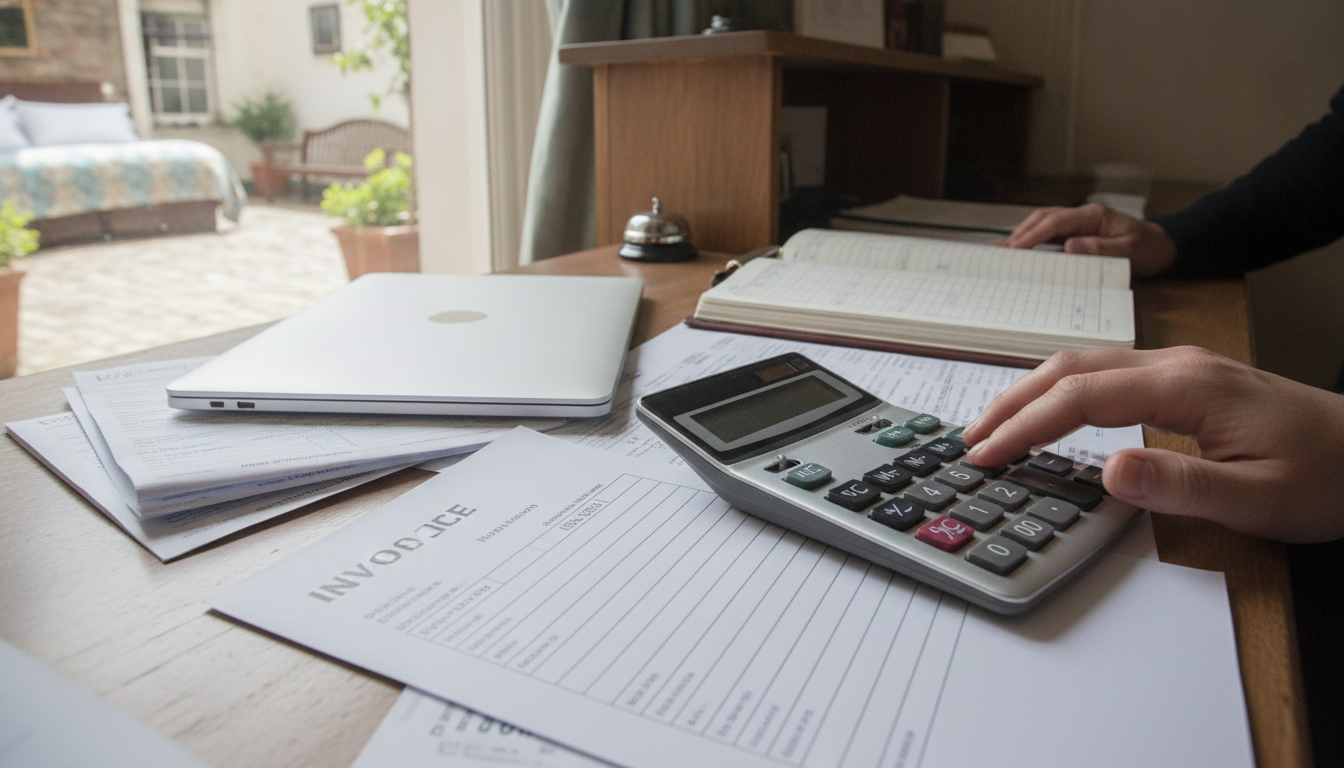
Independents with contract business — councils, construction firms, agencies — often carry a surprising invoicing burden. Purchase order numbers, consolidated monthly invoices, credit notes, VAT treatment on long stays, and chasing the ones nobody paid.
This is where manual process hurts most, because an error is not just lost time, it is a delayed payment. We regularly see properties where nobody can say, on demand, what a given council actually owes — because the figure on the screen mixes invoiced nights with nights that were never billed.
Automate: invoice generation, VAT handling, and a genuine outstanding-balance figure that distinguishes "invoiced and unpaid" from "not yet invoiced".
Keep human: the chase itself, and anything involving a credit note. Those need a person who knows the relationship.
4. Arrivals, departures and room moves — 1 to 2 hours
Rooms that need swapping because of a maintenance issue, a late checkout that pushes an arrival, a group that wants to be on the same floor. This work is genuinely operational, but it is slowed enormously by a calendar you cannot drag and drop.
Automate: nothing about the decision. Speed up the mechanics — a room move should be one drag, and it should update the channel manager without a second thought.
5. Reporting — 1 to 2 hours
Occupancy, ADR, RevPAR, the monthly figures for the accountant, the numbers the bank asked for. Many properties still assemble these in a spreadsheet from exports, which means the report is out of date the moment it is produced.
Automate: all standard reporting. If you cannot see last month's RevPAR in under ten seconds, you are paying for that number twice — once to produce it, once in the decisions you delayed while waiting.
6. Keeping the website alive — 1 to 2 hours, or never
Updating offers, changing photographs, publishing something that shows the hotel is a going concern. In practice this is the task that gets dropped first, which is why so many independent hotel websites have a "Christmas 2023" banner in June.
Automate: the routine content and the room imagery. Keep human: anything that speaks in the hotel's voice — your response to a review, your description of the restaurant, the note about the dog-friendly rooms. Guests can tell.
What this adds up to
Eight to sixteen hours a week of administration, most of it repetitive, in a business whose actual product is hospitality. For an owner-operator, that is the difference between working in the hotel and working on it.
The honest caveat: no system removes all of it, and you should be suspicious of anyone who says otherwise. What good software removes is the duplicate work — the same rate typed into three systems, the same guest keyed in twice, the same figure recalculated every month. That is usually where two thirds of the time goes.
Try the audit
For one week, write down every administrative task, who did it, and how long it took. Then mark each one:
- D — duplicate entry. The information already exists somewhere in your systems.
- R — routine. Same steps every time, no judgement involved.
- J — judgement. Needs a person who knows the property.
Everything marked D or R is a candidate for automation, and the D items should go first — they are pure waste and they are where mistakes come from. What is left marked J is the actual job.
Most properties that run this exercise find the same thing: they are not short of staff. They are short of a system that only asks them for a piece of information once.
InnCloud combines PMS, channel manager, booking engine and website in one platform, so rates, availability and guest details are entered once and flow everywhere. Book a demo or start a 7-day free trial.
One platform for your whole hotel
PMS, channel manager, booking engine and website — flat monthly price, no commission on your bookings.
Start your 7-day free trial